
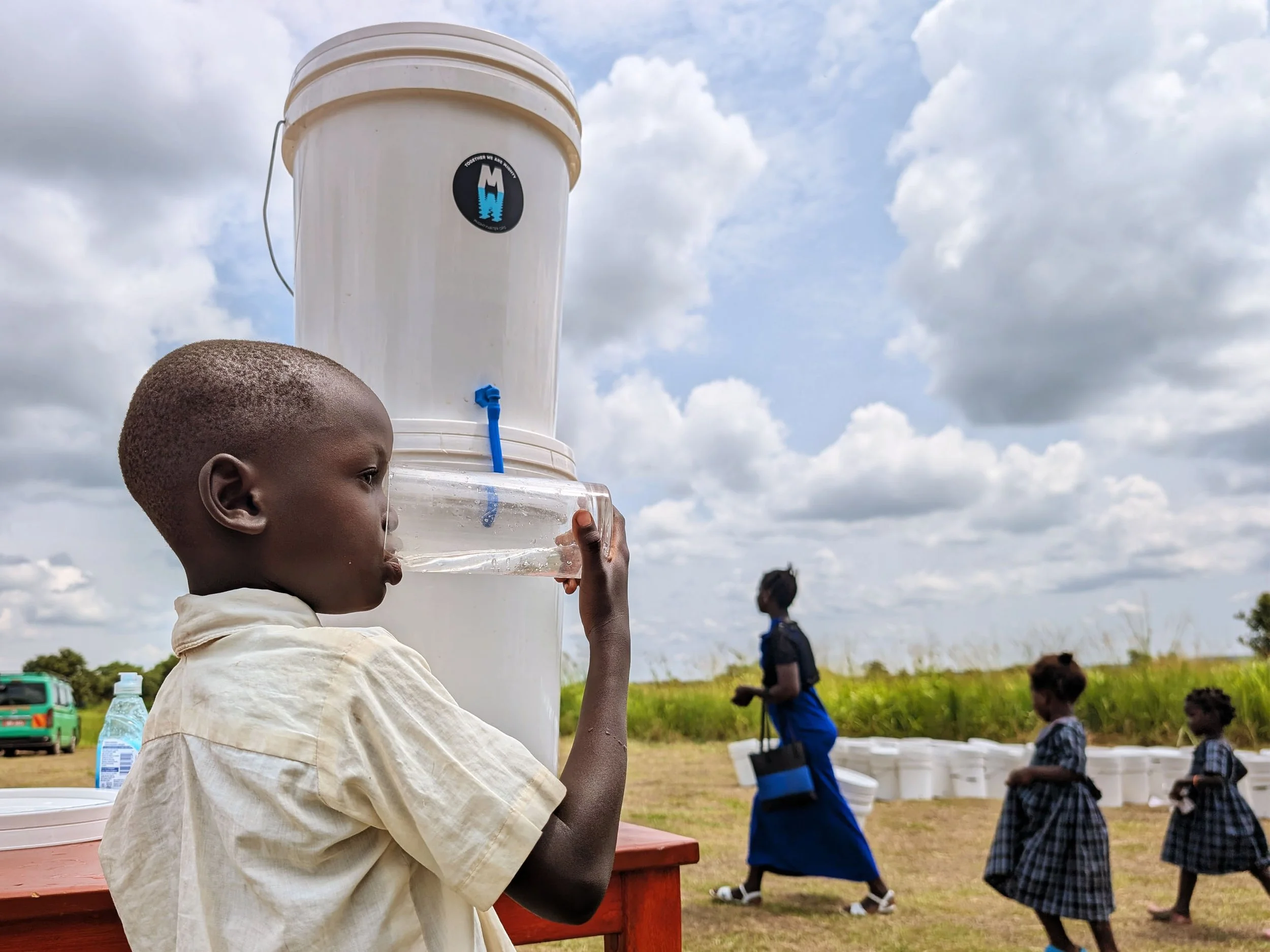
Sustainable Clean Water For Everyone
Today, 2.2 billion people lack access to safely managed drinking water
The Water Charity Challenge
Sustainable Clean Water
The need for clean water is massive. Every day, millions of people wake up concerned about the amount of water they have stored for the day and how to make it safe for their families to drink. At Mighty Water, we believe sustainability starts with affordability and grows when the benefits of clean water outweigh the cost. Our role is not simply to give, but to develop sustainable economies where solutions can grow and continue long after charitable support ends.
A Start-Up Mindset
Inspiring self-reliance
Start-ups are known for taking risks to prove new ideas can work. In many ways, nonprofits take an even greater risk. We step into places where markets do not yet exist, resources are limited, and communities may have never been exposed to clean water technologies. By introducing practical solutions and building local ownership, we aim to inspire entrepreneurs and communities to create lasting systems that improve health, education, and economic opportunity.
We started with a simple, powerful question: What do you need to improve your life? And when families answered, we listened — then we took action, empowering communities with the tools to improve their health and their household economics. The key to sustainability is affordability. The value proposition is that clean water will cost less than the regular treatments for the waterborne diseases it prevents.
Long-term Affordability
Clean water within reach for every family
“In Uganda, it costs over two weeks income to take a taxi to the doctor, get a test, and get the treatment for typhoid for a single family member. For much less, they can prevent typhoid for their entire household for three years with these filters.”
Building a Clean Water Economy
Turning water access into ownership and opportunity
We build sustainable water systems by progressing from direct delivery to local ownership and, ultimately, market-driven distribution. This model reduces dependency, strengthens accountability, and creates durable access to safe water. By aligning community needs with local capacity and simple economics, we enable programs that scale, sustain themselves, and deliver measurable health impact over time.
Mighty Partnership
We work with regional partners to implement community-led programs in areas reliant on untreated water, delivering filtration solutions alongside training and monitoring to ensure safe, consistent use.
Mighty Affiliate
We equip independent organizations with standardized tools, training, and shared data systems to operate self-funded, self-managed programs with clear performance metrics.
Mighty Enterprise
We support local entrepreneurs with microloans, mentorship, and supply chain access to build viable distribution businesses through kiosks and retail channels.
UNited Nations
Sustainable Development Goals (SDG’s)
The 2030 Agenda for Sustainable Development, adopted by all United Nations Member States in 2015, provides a shared blueprint for peace and prosperity for people and the planet, now and into the future. At its heart are the 17 Sustainable Development Goals (SDGs), which are an urgent call for action by all countries - developed and developing - in a global partnership. They recognize that ending poverty and other deprivations must go hand-in-hand with strategies that improve health and education, reduce inequality, and spur economic growth – all while tackling climate change and working to preserve our oceans and forests.
1. (UN) 2023 The 17 Goals, https://sdgs.un.org/goalsSDG 6 - Clean Water and Sanitation
Achieving universal coverage by 2030 will require a 6-fold increase
Billions of people still lack access to safe water, sanitation, and hygiene, despite improvement in the provision of these basic services. Water scarcity is a growing problem in many parts of the world, and conflicts and climate change are exacerbating the issue. In addition, water pollution is a significant challenge which affects both human health and the environment in many countries. Achieving universal coverage by 2030 will require a 6-fold increase in current global rates of progress on drinking water, a 5-fold increase for sanitation, and an 8-fold increase for hygiene. Boosting infrastructure investment, improving cross-sectoral coordination, and addressing climate change is key to getting SDG6 back on track.
Targets 6.1 and 6.2: Despite progress, 2.2 billion people still lacked safely managed drinking water services, 3.4 billion lacked safely managed sanitation services, and 1.9 billion lacked basic hygiene services in 2022. While the majority live in rural areas, the unserved population is decreasing in rural areas and stagnating or increasing in urban areas. Achieving universal coverage by 2030 will require an increase of 5 to 8 times the current rate.
2. (UN) 2023 Progress and Info, https://sdgs.un.org/goals/goal6#progress_and_infoSDG 12 - Responsible Consumption and Production
Intelligent resource use to align with the sustainable development goals
Mass production and consumption of plastic, especially that of single-use packaging plastic, are major contributors to plastic pollution in the sea and on land. This pollution has a negative influence on our ecosystems and endangers the lives of every living being.
Our promise to responsible design is to evaluate the effects of our work on everyone and everything it touches. We ask these five questions about materials because it is the right thing to do.
-
Minimize the consumption of raw materials.
Filter kit uses minimal materials with a weight of 106g (0.23lbs).
Filter system eliminates the need for wood and charcoal to boil water.
Filter Technology eliminate the need for chemicals to treat water.
-
Utilize sustainable and compostable materials.
Packaging is made of compostable bioplastics
Hand tools are made of sustainable wood and recyclable metals.
-
Minimize shipping carbon footprint.
Our filter kit nests efficiently using minimal packaging fitting 40 units into a 16×12×10in (40×30×25cm) box and 120 units into our travel-ready duffle bags.
-
Minimize waste of expendables.
Our filters are function-focused with no cosmetic parts to be discarded.
-
Do not leave behind anything that cannot be composted, recycled, or repurposed.
Carry-out all unwanted shipping bags to local composting or recycling centers.
